ECB communication and money market rates
March 2026
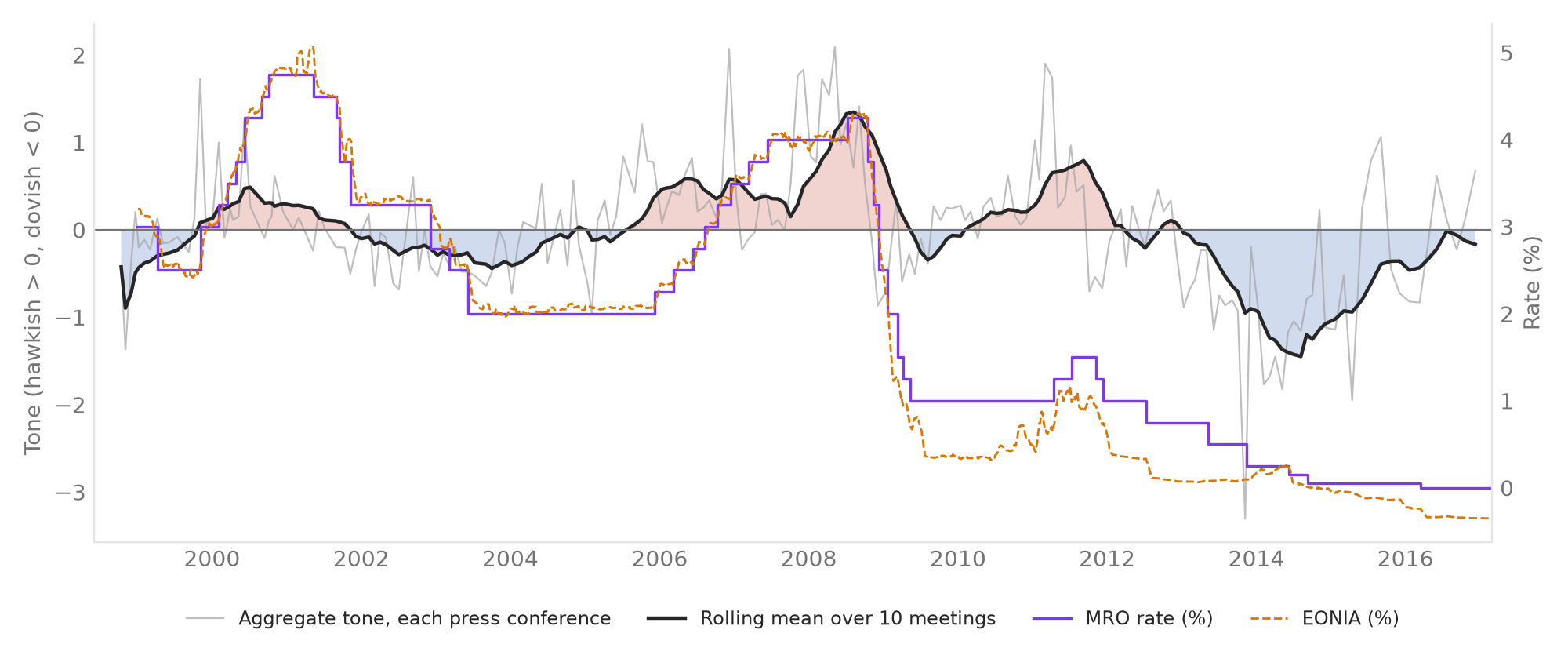
A replication of Czudaj and Nguyen (2025). I score the tone of every ECB press conference with a hawkish/dovish dictionary, then test whether that tone predicts the overnight interbank rate beyond the policy rate itself.
Question
Central banks do not only move rates, they also talk. Czudaj and Nguyen (2025) build sentiment indices from the ECB’s press conferences and show that their tone predicts the interbank rate beyond the information in the policy rate decision. I reimplemented their method from the paper to check whether the result holds.
Method
A score for each press conference.
Each transcript is split into sentences.
Around every occurrence of inflation, interest rate(s) and unemployment, I keep the 10 words before and after and remove stop words.
These words are matched against the paper’s dictionary of hawkish and dovish terms, including truncated patterns such as ris* or increas*.
A window scores its hawkish matches minus its dovish matches, divided by its length, and the window scores are summed into three topic indices and an aggregate one.
Predictive regressions. For each index X and each lag k from 0 to 12 press conferences, I estimate
EONIA_t = β0 + β1 · X_{t−k} + β2 · MRO_t + ε_tby OLS with HAC standard errors (4 lags), where EONIA is taken on the day of the press conference and MRO is the ECB’s main refinancing rate. β1 measures what the past tone adds to the current policy rate.
Validation
| Check | Replication | Paper |
|---|---|---|
| Example sentence of the paper, inflation score | −0.333 | −0.33 |
| Inflation index, mean and std | 0.13, 0.54 | 0.06, 0.51 |
| Aggregate index, mean and std | 0.00, 0.73 | −0.16, 0.70 |
| Correlation with the paper’s Figure 2, 1998-2016 | 0.69 | |
| Pass-through coefficient β2 | 1.15 | about 1.14 |
The transcript corpus I used stops in December 2016, so the sample has 205 press conferences instead of the paper’s 266.
Results
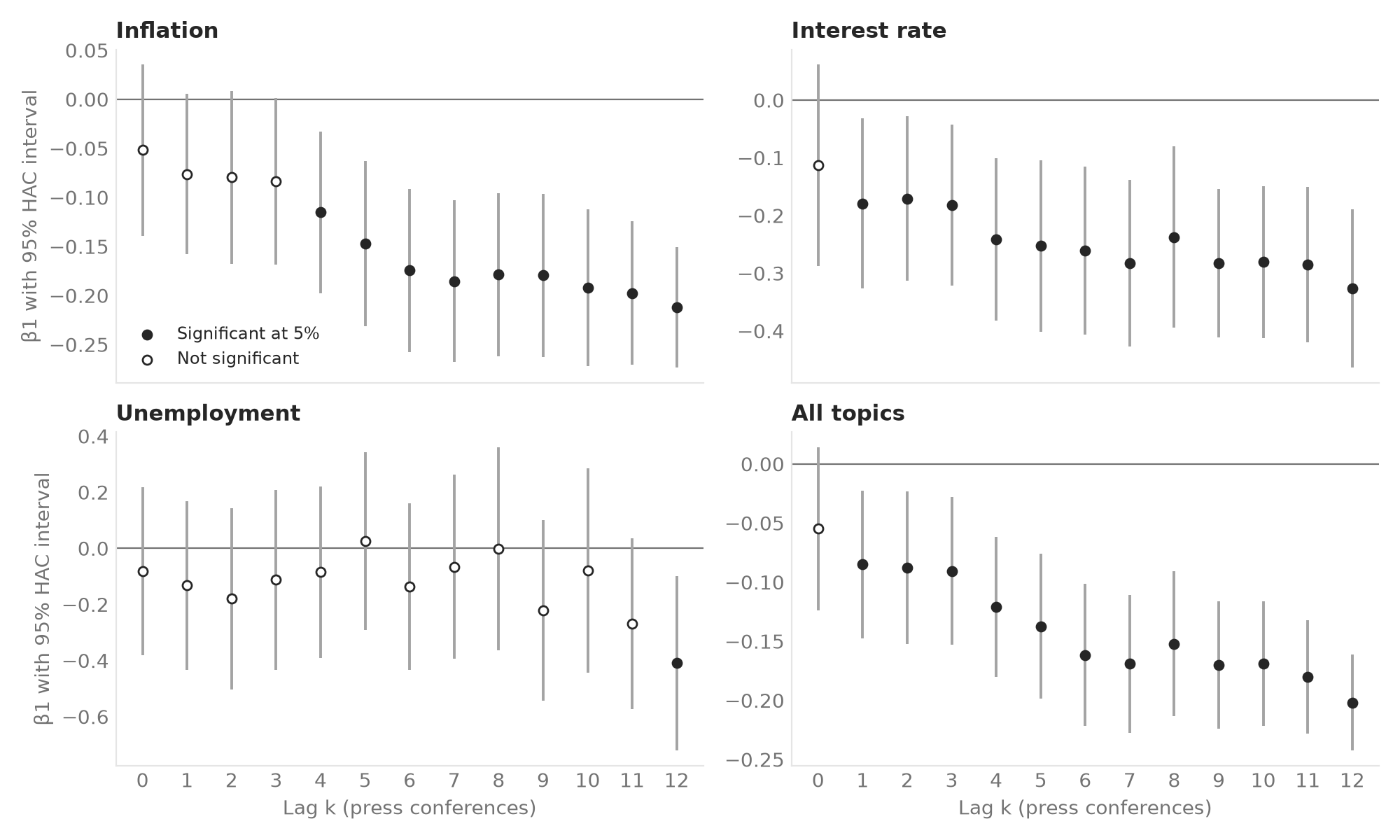
- Inflation and interest rate sentiment have a negative and significant coefficient from a lag of 4 and 1 press conferences, and it grows with the lag.
- Aggregate sentiment is negative and significant from lag 1.
- Unemployment sentiment is mostly not significant.
These signs are the paper’s. Its reading: the policy rate passes through to EONIA slightly above one, so the market overreacts a little to rate decisions, and the negative sentiment coefficients act as a correction.
Limitations
A bag-of-words score misreads context. “Inflation is not expected to rise” scores as hawkish, because “not” is removed as a stop word, and “we see downside risks to inflation” also scores as hawkish, because the pattern ris* matches “risks”.
This may explain part of the rise of the index after 2014, when rates stay at zero and the ECB talks about future normalization instead of moving rates.
The sample ends in 2016, and the paper’s robustness check with the deposit facility rate is not reproduced.